

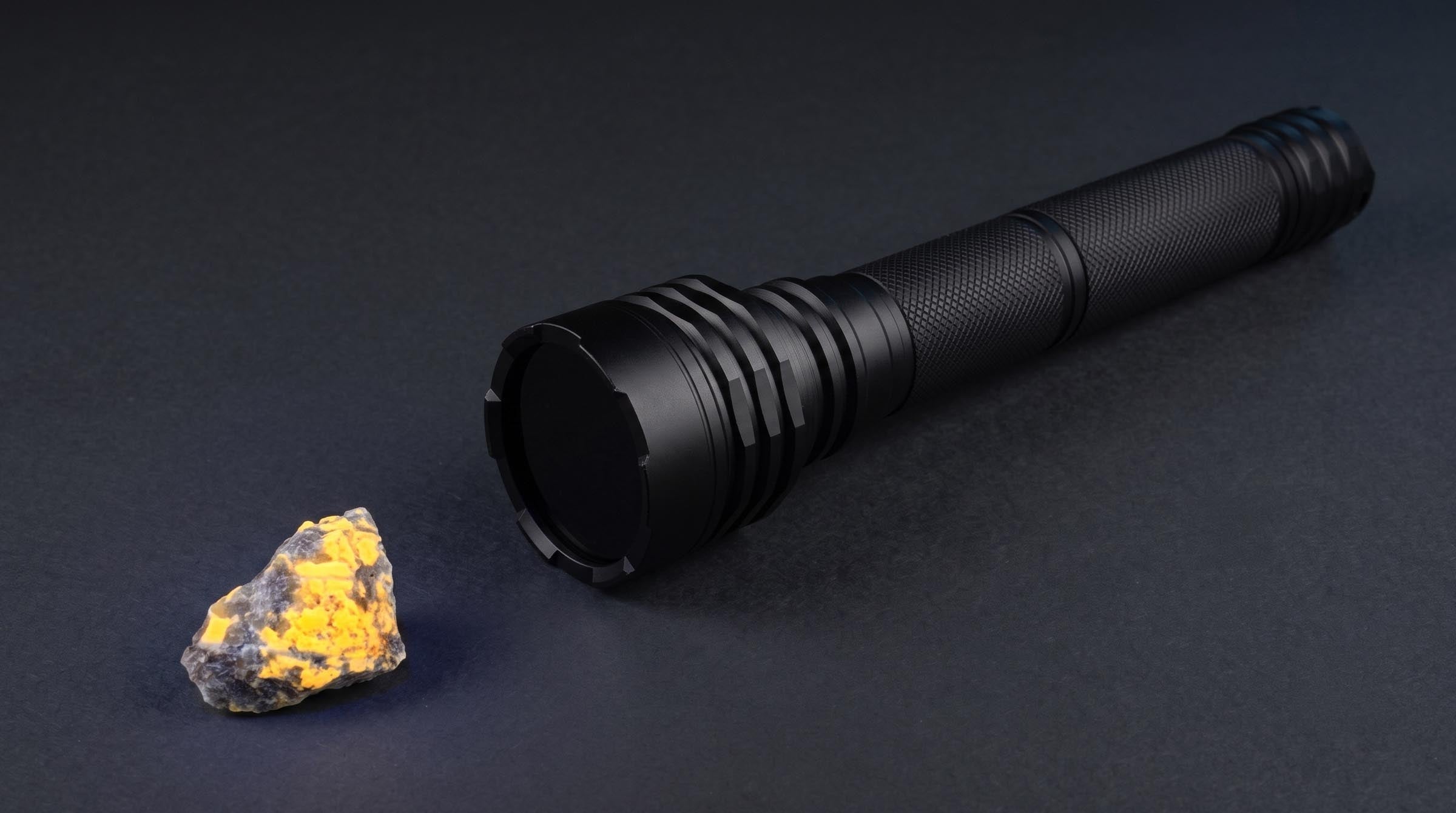
Best UV Flashlight for Yooperlites: What Actually Matters
If you are searching for fluorescent minerals or Yooperlites, the goal is simple: make the right target stand out against the ground around it. The complication is that rocks do not all respond to the same wavelength, and the brightest-looking blacklight is not necessarily sending the most useful UV to the material.
Here’s what the bargain bin won’t tell you: fluorescent minerals, Yooperlites, and uranium glass are not one category. They don’t all react to the same wavelength, and they don’t all react with the same enthusiasm. So the useful question isn’t “will this light make rocks glow.” It’s “is this the right UV tool for this material and this search?”
Start With the Wavelength
For longwave-reactive targets—including Yooperlites, uranium glass, and many fluorescent rocks—a filtered 365nm light is a strong starting point. Field searching depends on contrast, and visible purple spill can make a subtle reaction harder to distinguish from sand, gravel, and surrounding rock.
Learn more: Why More Purple Light Doesn’t Mean More UV Power
365nm Is Not Universal for Minerals
Now the caveat that actually matters, and I’ll say it plainly because plenty of sellers won’t: 365nm is longwave UV, and not every mineral cares. A lot of the classic, collection-grade fluorescent minerals respond better to shortwave UV, which is a completely different tool. That doesn’t make 365nm useless for rockhounding — it makes it the right light for longwave targets and the wrong light for a shortwave specimen. Match the light to the material and you’ll be happy. Expect one 365nm flashlight to conquer every rock on Earth and you won’t.
Learn more: Longwave vs Shortwave UV for Fluorescent Minerals: What Buyers Should Know
Filtering, Beam Shape, and Output Still Matter
Wavelength gets the headline, but the whole tool has to show up. A weak 365nm light still disappoints. A poorly filtered one still throws purple spill. A pinpoint beam makes scanning a chore, and a wide, thin beam spreads the UV too far to spark much of anything. Filtering is the quiet hero here: a ZWB2 filter cuts the visible purple so color, edges, and faint reactions read clearly against a busy background of sand, dirt, and other rocks. It doesn’t add UV power. It clears the noise so you can see the signal.
Scout for Confirmation, Atlas for Searching
Which brings up size, and this is where the two-light logic kicks in. A compact light like the Scout 365nm is great for close checks — confirming a rock once it’s in your hand, quick indoor inspection, tossing in a bag. But field searching is a different animal. When you’re walking a beach, sweeping gravel, or scanning a mine dump across uneven ground, you need coverage and sustained output, and that’s the Atlas 365nm’s whole job. The Atlas isn’t “the better light.” It’s the light built for covering ground.
Do Not Confuse a Visible Beam With Useful Range
Distance deserves a hard look too, because “long range” is the most abused phrase in UV marketing. A beam you can see landing forty feet away means nothing if the target doesn’t still fluoresce clearly at that distance. That’s the number that matters, and it’s the one cheap sellers never publish.
Learn more: Long Range UV Flashlights: What Actually Matters at 10, 20, 30, and 40 Feet
A Simple Mineral-Light Decision
1. Identify whether the target responds to longwave 365nm or requires shortwave UV.
2. Choose Scout for specimens in hand and other close checks.
3. Choose Atlas for beaches, gravel, mine dumps, and other searches where coverage and distance matter.
So here’s the honest buyer’s version. For longwave targets — Yooperlites, uranium glass, scorpions, and many fluorescent rocks — a filtered 365nm light gives you cleaner contrast and a real shot at the good stuff. Pick the Scout for close checks and the Atlas for covering ground, match the wavelength to the material, and don’t fall for a purple beam pretending to be power. The brightest-looking blacklight is almost never the best mineral light.
Written by Pierce Henley
For more about Pierce's UV engineering background check out our about FORAY page.