

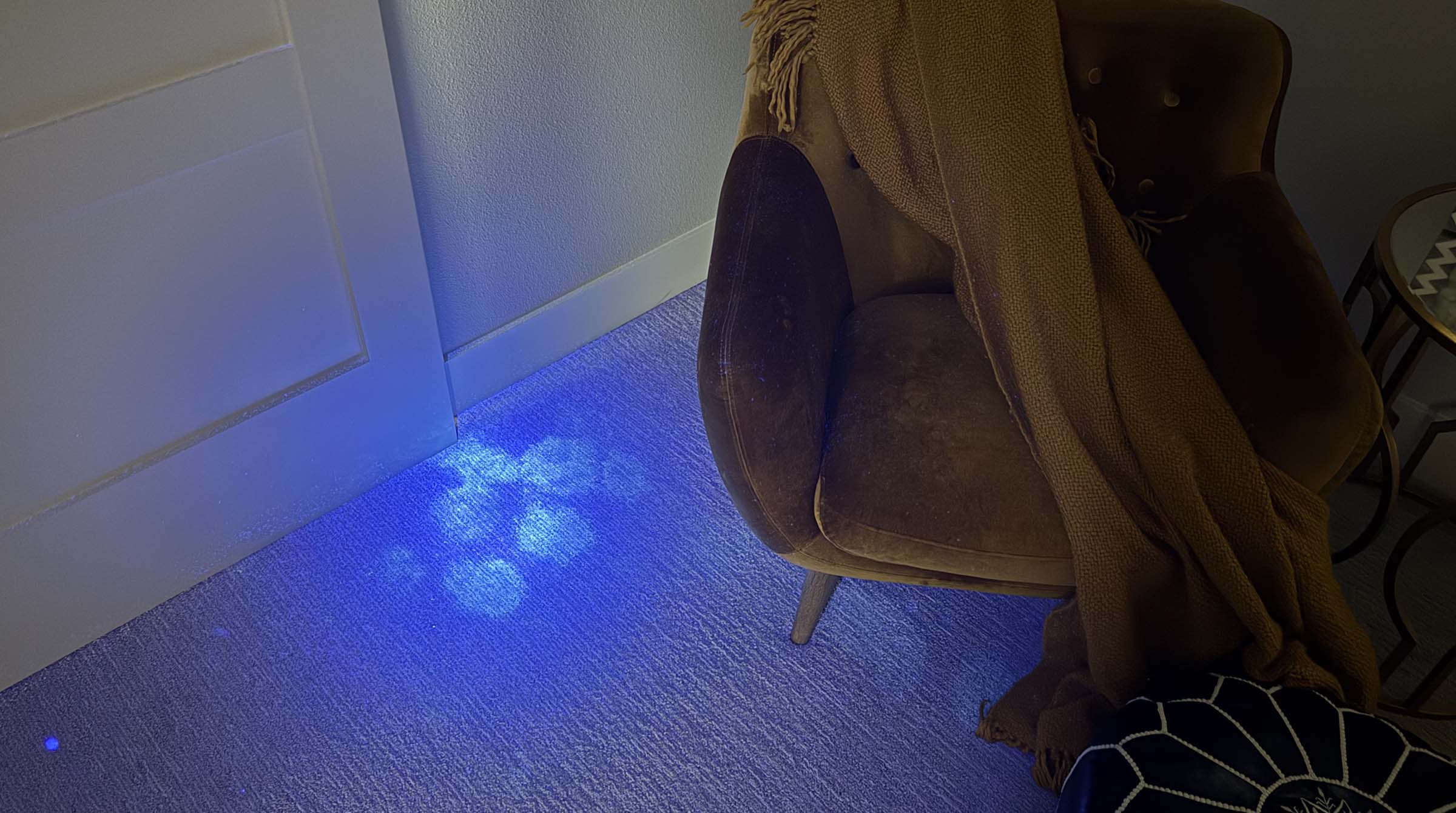
Best UV Flashlight for Pet Stain Detection: Dogs and Cats
When a room smells wrong but the source is not obvious, you need a faster way to narrow the search. A UV flashlight can help reveal suspicious areas left by dogs and cats, giving you a place to inspect and clean instead of treating the entire room.
The honest limit is just as important: a UV reaction is a clue, not proof of urine. Some real stains will not fluoresce, and cleaners, fibers, food residue, and other household materials can glow too. Used with that expectation, a filtered 365nm light becomes a practical first-pass tool rather than a magic detector.
Why Scout Fits Pet-Stain Searches
For this job the right tool is a compact, filtered 365nm light, and the Scout 365nm is built for exactly it: small enough to live in the cleaning kit, close-range friendly, and filtered so suspicious spots stand out instead of drowning in purple haze.
Why Wavelength and Filtering Matter
Why 365nm and not the cheap purple blacklight at the checkout counter? Because those run nearer 395nm, and most of that beam is visible violet your eyes already see. The room glows, the carpet glows, everything glows, and the one thing you’re hunting blends right in. A 365nm light throws far less visible purple, so the stain gets to stand out against a dark background. Contrast is the whole game here, and beam drama is the enemy of contrast.
Learn more: Why More Purple Light Doesn’t Mean More UV Power
Filtering pushes that further. A ZWB2 filter scrubs the leftover visible purple off the beam so you’re reading fluorescence, not fighting glow. The light looks calmer to your eye and the actual stain gets easier to spot — exactly the trade you want on carpet, rugs, and textured surfaces where a busy background hides things.
Learn more: What Is a ZWB2 Filter in a 365nm UV Flashlight?
How to Search a Room
Using it well is mostly technique. Get the room as dark as you can — real dark, not dusk. Work in sections instead of sweeping the whole floor at once, and start where trouble lives: corners, doorways, rug edges, baseboards, litter-box zones, pet beds, furniture legs, and wherever the smell is strongest. Keep the light close to the surface; back too far off and the beam spreads and the reaction fades. When something glows, don’t call it on the spot. Read the shape, the location, the surface, and the smell, then decide whether it needs cleaning, treating, or a second look once it dries.
Understand Misses and False Positives
Expect some stains to stay invisible, and don’t take it personally. Old residue, a spot cleaned with the right product, a surface that swallows the stain, a room that isn’t dark enough, or a light held too far away will all keep a real stain dark. UV improves your odds of spotting trouble. It doesn’t promise you’ll see all of it.
Expect false positives too, because a glow is not a confession. Laundry detergent, cleaning products, fabric fibers, food residue, lotions, dust, some plastics, and the optical brighteners baked into half your household materials all fluoresce cheerfully. That’s not the light failing — that’s UV doing its job. The glow tells you where to look closer. Your eyes and nose finish it.
What to Look For in a Pet-Stain Light
So what actually matters in a pet-stain light? Not size, not lumens, not how purple it looks in the box. It needs to be easy to use indoors, filtered enough to give you clean contrast, and handy enough that you’ll actually grab it when a room smells off at 9pm. That’s a close-range inspection tool, and for most homes the Scout 365nm is right-sized for it.
Learn more: Best Compact 365nm UV Flashlight for Pet Stains, Hotel Rooms, and Home Inspection
When a Larger Light Makes Sense
There’s a point where you’d want more light — scanning big rooms, working through a stack of rental units, or checking commercial spaces where you’re covering ground instead of corners. That’s when the larger Atlas 365nm earns its keep. For one house and one stubborn cat, it’s overkill. Match the light to the size of the search.
Find, Clean, Check Again
1. Darken the room and scan likely pet areas slowly with the light close to the surface.
2. Confirm suspicious reactions using pattern, location, odor, and surface context.
3. Clean or treat the area, let it dry, and inspect it again.
Bottom line: the best pet-stain UV flashlight is the one that helps you inspect close-range areas clearly and honestly. It finds the suspicious areas fast. It doesn’t diagnose them for you. Use it as the sharp first pass it is, and let your own judgment call the verdict.

Written by Pierce Henley
For more about Pierce's UV engineering background check out our about FORAY page.