

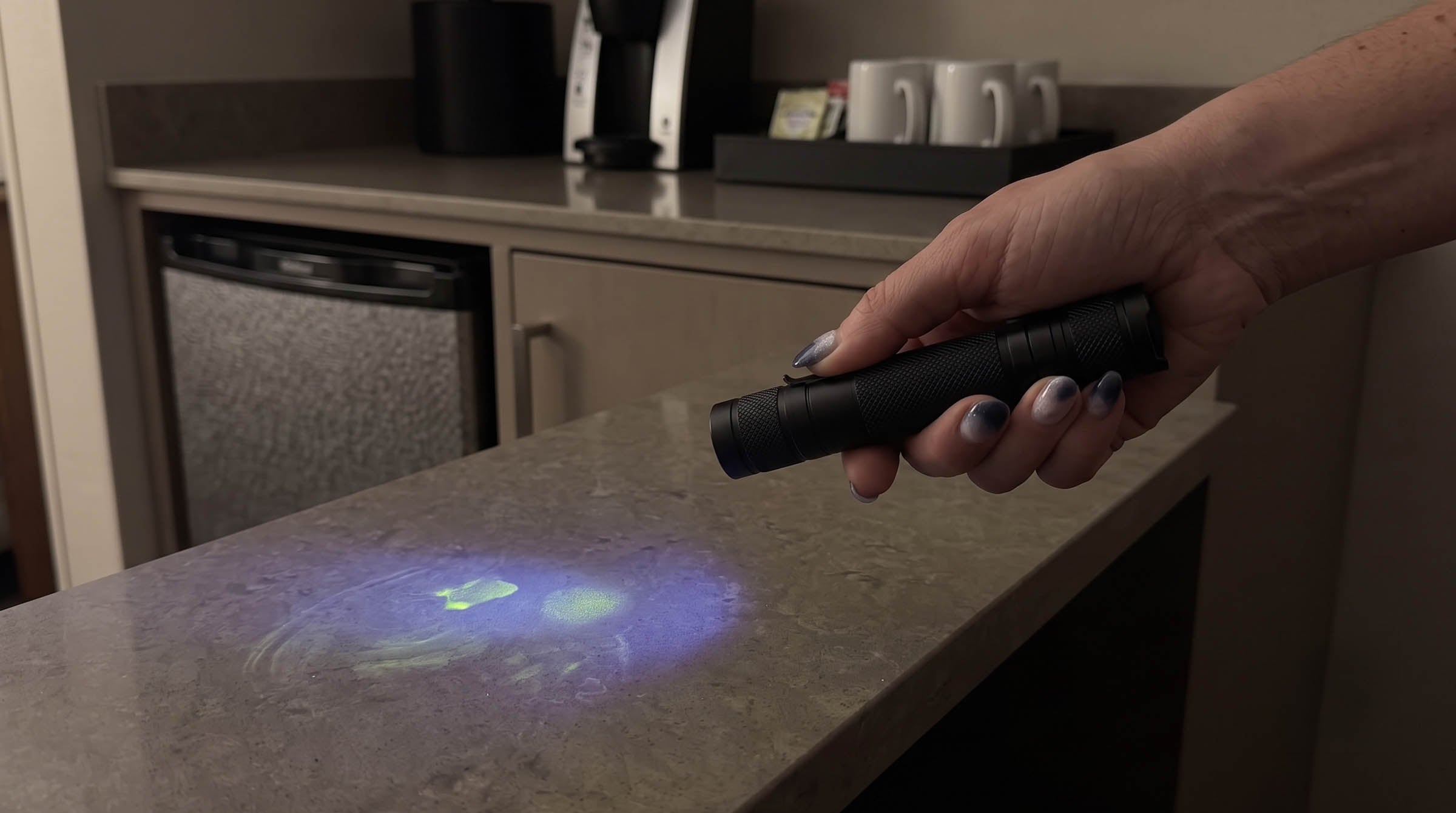
UV Flashlight for Hotel Room Inspection: What It Can and Cannot Show
When a hotel room looks clean but you still want a quick check before settling in, a UV flashlight can help reveal stains and residue that ordinary room lighting hides. The key is interpreting what you see without turning every glowing fiber into a verdict.
A compact filtered 365nm light fits this job because hotel inspection happens close to bedding, upholstery, carpet, and bathroom surfaces. It can flag an area worth a closer look, but it cannot identify the substance or prove the room is unsafe.
A Glow Is a Clue, Not a Diagnosis
Because that’s the honest limit: UV shows that something reacts, not what it is. It can’t prove a glow is a bodily fluid, prove a surface is contaminated, or prove a room is unsafe — and a clean scan doesn’t prove the room is spotless either. A washed sheet can glow from detergent or fabric brightener; a bathroom fixture can glow from cleaner; a carpet mark could be a spill, a stain, or residue. What matters is context — pattern, shape, location, odor, surface — not a single glowing speck. Read the situation, then decide whether to request a room change, clean it yourself, avoid the spot, or flag it to staff.
Why Filtered 365nm Fits Surface Inspection
On the light, 365nm beats a cheap 395nm blacklight for the same reason it always does: less visible purple in the beam means the reaction stands out instead of the whole room turning into a purple wash. You’re not throwing a rave; you’re trying to read surfaces. Filtering sharpens that further — a ZWB2 filter cuts the leftover spill so carpet, bedding, and bathroom tile stay readable in a dim room. It looks calmer than a blacklight, and that calm is the point.
Learn more: 365nm vs 395nm UV Flashlights: What’s the Difference?
Learn more: What Is a ZWB2 Filter in a 365nm UV Flashlight?
Why Scout Fits the Travel Bag
Size is easy here: hotel inspection is close-range, packable work, which is exactly the compact Scout 365nm’s job. It fits a travel bag, handles tight rooms without being awkward, and comes out fast when something looks or smells off. A big field light works too, but it’s more than a nightstand check needs.
Learn more: Best Compact 365nm UV Flashlight for Pet Stains, Hotel Rooms, and Home Inspection
How to Inspect Without Overreacting
Technique keeps it sane. Kill the lights, work the room in sections so your eyes actually read what the beam shows, and hit the spots that matter rather than auditing every square inch for an hour: pillow and sheet edges, mattress seams, the chair, carpet near the bed, the bathroom floor and fixtures, high-touch surfaces, and anywhere with an odor. When something glows, weigh the context before you decide anything.
Know When UV Adds Value
And keep some perspective. Don’t assume every glow is dangerous or every dark surface is clean, and don’t turn a travel tool into a paranoia machine. If a room smells bad, looks dirty, or has visible stains, you didn’t need UV to tell you that — trust your own senses too. Where the flashlight earns its place is the uncertain middle: the room looks fine but something feels off, you want to check the bedding edges, you’re traveling with pets, or you just sleep better having looked.
A Three-Minute Room Check
1. Darken the room and inspect the highest-value areas first.
2. Read any reaction using pattern, location, odor, and visible condition.
3. Decide whether to ignore it, avoid the area, clean it, or ask hotel staff for help.
Bottom line: a UV flashlight is a useful hotel screening tool, and a filtered 365nm light like the Scout makes the suspicious stuff easier to spot without lighting up the whole room. It helps you notice. It doesn’t decide. Use it to make a smarter call, not to lose sleep.

Written by Pierce Henley
For more about Pierce's UV engineering background check out our about FORAY page.